We see it too often around Cary. A contractor builds a wall, skips the subsurface investigation, and within two seasons the face is tilting toward the street. The culprit isn't poor workmanship. It's the assumption that Piedmont residual soil behaves like fill from the last job in Raleigh. Our retaining wall design work in Cary starts with a simple rule: never guess what's below the root mat. Some lots in western Cary hit partially weathered rock at five feet; others in the Swift Creek basin find 20 feet of silty sand. An SPT drilling program pinpoints that transition before we draw a single cross-section. For taller walls in commercial subdivisions, we often pair the borings with a slope stability analysis to confirm global factors of safety exceed 1.5 under saturated conditions.
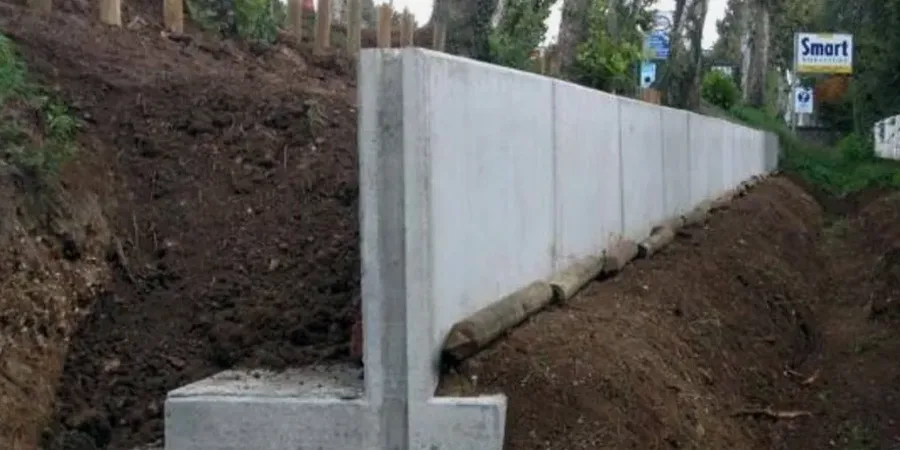
A retaining wall in Cary's residual soil fails from the base up. We design the drainage and reinforcement to keep the toe dry and the backfill locked.
How we work
Local ground factors
The number one failure mode we investigate in Cary isn't overturning. It's hydrostatic buildup behind the stem. Contractors sometimes omit the weep holes or wrap the drain in the wrong fabric. Within a wet spring, water pressure doubles the active thrust on the wall, and the footing begins to rotate. Another local risk is constructing over mica-rich schist saprolite. This material looks competent in a test pit but loses strength when exposed to air and water. We specify a protective shotcrete coating or permanent formwork for cut faces in these zones. Seismic demand is moderate in Wake County, but walls over 12 feet require a pseudo-static analysis per ASCE 7-22. We run that check early so the reinforcement detailing doesn't need a late change order.
Regulatory framework
IBC 2021, Chapter 18 (Soils and Foundations), ASCE 7-22, Minimum Design Loads, AASHTO LRFD Bridge Design Specifications, 9th Ed., ASTM D4767 (Consolidated Undrained Triaxial), NCDOT Standard Specifications for Roads and Structures
Complementary services
Residential Tiered Walls
For steep Cary lots in developments like Amberly or Preston. We handle the Town's slope disturbance permit requirements, design the drainage blanket, and coordinate with the grading plan to minimize fill import.
Commercial MSE and Gravity Walls
For shopping center pads and detention ponds. We design the geogrid layout, select the facing panel type, and verify bearing capacity on the residual soil profile. Package includes global and internal stability calculations.
Waterfront and Stream Buffer Walls
Cary's Jordan Lake watershed rules require extra scrutiny. We design walls within buffer zones using non-erodible backfill, scour protection at the toe, and conservative global stability modeling for rapid drawdown conditions.
Typical parameters
Questions and answers
What does a retaining wall design package cost for a typical Cary residential lot?
For a single-family lot retaining wall design in Cary, our fee typically ranges from US$960 to US$4,200. The final number depends on wall height, whether a boring or test pit is needed on your specific lot, and the level of Town submittal support. A 4-foot segmental block wall with straightforward access falls at the lower end; a 10-foot reinforced concrete wall with drainage calculations and a signed seal for permitting sits at the upper end.
Does the Town of Cary require a stamped design for a retaining wall?
Yes. The Town of Cary requires a North Carolina-licensed professional engineer's seal on retaining wall plans when the wall exceeds 4 feet in height or supports a surcharge such as a driveway or structure. We prepare the sealed calculations, construction drawings, and drainage details that the Inspections & Permits Department expects to see at plan review.
How long does a retaining wall design take from field visit to sealed plans?
A typical timeline for a Cary retaining wall design runs three to four weeks. Week one covers the subsurface investigation, either a test pit or SPT boring. Week two is laboratory testing of the recovered samples. Weeks three and four are the design, drafting, and internal peer review. Expedited schedules are possible when the contractor has a tight grading window.
What soil information do you need before designing a wall in Cary?
We need the strength parameters of the foundation soil and the proposed backfill. For walls under 6 feet on undisturbed Piedmont residual soil, we may use a test pit logged per ASTM D2488 and index property testing. For taller walls or any wall supporting a structure, we perform SPT borings and a triaxial test to obtain the drained friction angle and cohesion intercept. We also map the depth to partially weathered rock, which is common in western Cary.