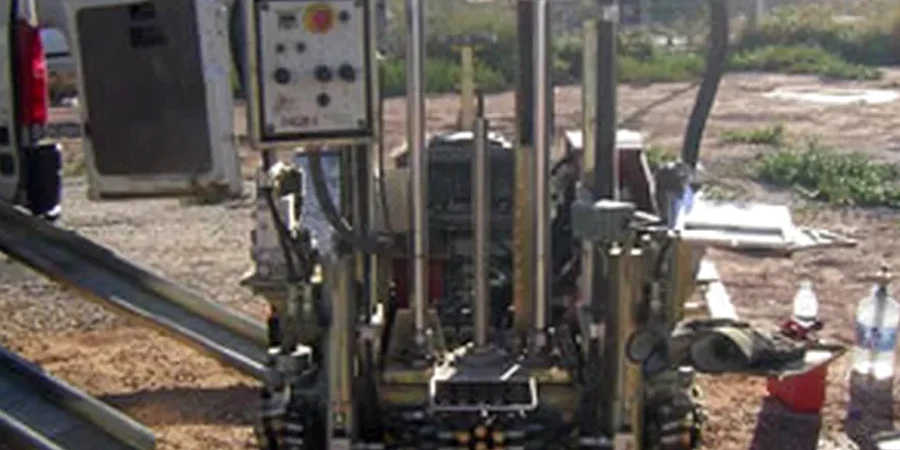
A 20-ton truck-mounted rig with a hydraulic push system positions the cone over the test point, and within minutes the 15 cm² conical tip begins its continuous descent at 2 cm/s into the subsurface. In Cary, where the Triassic sedimentary bedrock of the Deep River basin transitions into weathered Piedmont saprolite, this penetration rate reveals subtle changes in silt content, clay seams, and partially weathered zones that conventional SPT sampling often misses. The cone penetrometer delivers three simultaneous channels of data: tip resistance (qc), sleeve friction (fs), and dynamic pore pressure (u2). Together, these parameters build a high-resolution soil behavior type profile at 2 cm vertical intervals. For sites near the Carpenter Fire Station Road widening or along the future 540 extension corridors, we run the rig with a seismic module to capture shear wave velocity without a separate borehole. When the project demands deep foundation analysis, the CPT data pairs naturally with pile design parameters to refine shaft resistance and end-bearing estimates before a single auger hits the ground.
At 2 cm vertical resolution, a single CPT sounding in the Cary Triassic basin provides more stratigraphic detail than a dozen SPT borings combined — and it does it in under two hours.
How we work
Local ground factors
A developer planned a four-story medical office building on a 2.3-acre parcel off Kildaire Farm Road. The preliminary geotechnical report, based on three SPT borings, classified the site as stiff clay over weathered rock and recommended spread footings at 2.5 meters. After excavation began, the contractor hit a 1.8-meter-thick lens of loose silty sand at the northwest corner — completely missed by the borings. The footing design had to be revised mid-construction, adding two weeks of delay and a column load redistribution. A single CPT sounding in that corner would have detected the loose lens immediately through the drop in tip resistance and the spike in pore pressure. In Cary's transitional Piedmont geology, where depositional contacts between the Triassic basin sediments and the residual soil mantle are rarely horizontal, the continuous profile from a cone penetration test eliminates the blind spots inherent in 1.5-meter SPT intervals. The IBC requires two independent site investigation methods for seismic site class determination on critical structures; combining CPT with MASW surveys satisfies that requirement while building a defensible Vs30 profile.
Regulatory framework
ASTM D5778-20 (CPT/CPTu), IBC 2021 Chapter 18 (soils and foundations), ASCE 7-22 Chapter 20 (site classification), NCEER 1997/Youd-Idriss 2001 (liquefaction triggering), ASTM D7400-19 (seismic CPT), and the Town of Cary Stormwater Management Manual (infiltration feasibility) govern the execution and interpretation of cone penetration testing for stratigraphic profiling without drilling.
Complementary services
Standard CPTu Sounding Program
Piezocone penetration with continuous qc, fs, and u2 logs. Includes soil behavior type classification per Robertson (1990, updated 2016), pore pressure dissipation tests at pre-selected depths, and a digital report with corrected cone resistance (qt) and normalized parameters plotted against depth. Suitable for foundation bearing capacity, settlement estimates, and liquefaction screening per NCEER methodology.
Seismic CPT with Vs Profiling
Same piezocone instrumentation plus a downhole triaxial geophone array. Shear wave velocity measured at 1-meter intervals during pauses in penetration. Delivers a continuous Vs profile for IBC/ASCE 7 site class determination (A through F) and ground motion amplification studies. The shear wave data also calibrates the small-strain stiffness for advanced constitutive models used in deep excavation and soft ground tunneling analyses.
Typical parameters
Questions and answers
How much does a CPT investigation cost for a typical single-family lot in Cary?
Can CPT replace soil borings entirely on my Cary commercial project?
CPT can replace a large portion of the boring program, but not always 100 percent. The cone penetrometer provides continuous stratigraphic data and excellent soil behavior classification, yet it cannot retrieve physical samples for laboratory testing. On commercial projects in Cary, the IBC allows CPT as the primary investigation method when supplemented by at least one soil boring or test pit to verify soil classification and collect samples for index testing. Our standard approach pairs three to six CPT soundings with one carefully located test pit to satisfy both the continuous profiling and sampling requirements in a single mobilization.
How long does a CPT field program take and when do I get the data?
A typical Cary commercial site with four to six soundings to 25 meters depth is completed in one field day. The crew mobilizes at 7:00 AM and typically demobilizes by 3:30 PM, depending on traffic on US-1 or I-40. Digital logs with soil behavior type, corrected cone resistance, and pore pressure profiles are available the same evening via secure download link. The formal signed geotechnical report with bearing capacity estimates, settlement analysis, and liquefaction screening follows within five to seven business days.