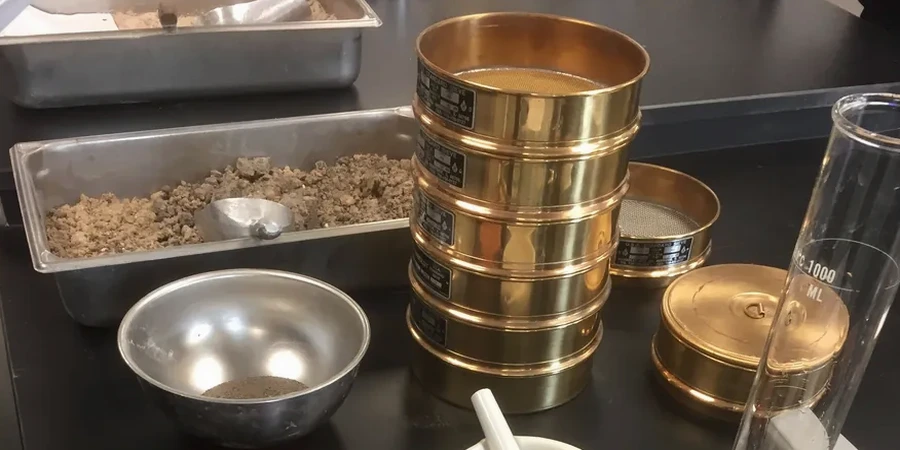
Assuming Cary soil is “just clay” because it’s red is a fast way to blow a compaction spec. Piedmont residual ground here runs from silty sand to fat clay within 50 feet, and guessing the gradation skips the single test that controls subgrade design, permeability, and filter compatibility. ASTM D6913/D7928 sieve stacks catch the coarse fraction while ASTM D7928 hydrometer readings pin down silt and clay percentages—numbers that dictate whether your stormwater basin works or your retaining wall backfill drains. We run the full curve, not just a partial wash, because Wake County reviewers want the complete picture. Before the crew cuts a foot too deep into weathered saprolite, pair the gradation data with an SPT drilling program to tie classification to actual blow counts across the site.
Gradation isn’t a formality—it’s the difference between a filter that drains and one that clogs in a Cary storm.
How we work
Local ground factors
Cary sits at roughly 480 feet elevation on the Piedmont fall-line transition, where residual soils can shift from well-graded silty sand to high-plasticity clay across a single building pad. A grain-size curve that misses the fines tail will undercount the clay fraction, leading to undersized stormwater filters, clogged French drains, or subgrade that pumps water under traffic. In 2023 several Wake County stormwater basins failed infiltration tests because the designer assumed a sandy loam from a visual log while the hydrometer later showed 40 percent minus-200 with a plasticity index above 25. That rework cost ran into five figures. When the gradation data feeds Atterberg limits from the same split, you get a defensible USCS classification that holds up under county review.
Regulatory framework
ASTM D6913 / D6913M-17: Standard Test Methods for Particle-Size Distribution of Soils, ASTM D7928-21: Standard Test Method for Particle-Size Distribution of Fine-Grained Soils Using the Sedimentation (Hydrometer) Analysis, ASTM D2487-17: Standard Practice for Classification of Soils for Engineering Purposes (Unified Soil Classification System), AASHTO T 88-22: Particle Size Analysis of Soils
Complementary services
Complete ASTM D6913 Sieve Analysis
Mechanical sieve stack from 3-inch down to No.200 with wash-through fines determination. We report percent retained on each sieve, cumulative passing curve, and D10-D30-D60 values for USCS classification.
Hydrometer Sedimentation (ASTM D7928)
Full 24-hour hydrometer run on the minus-200 fraction using ASTM 152H stem and sodium hexametaphosphate dispersant. Temperature-corrected readings at seven time intervals yield the fine-grained gradation curve and clay-silt split.
Typical parameters
Questions and answers
How much does a grain size analysis cost in Cary?
A standard sieve plus hydrometer package runs between US$100 and US$200 per sample, depending on whether you need a simple wash or the full sedimentation curve with Atterberg cross-check. Bulk pricing applies at five samples or more; we’ll quote your exact number once we know the project depth and how many distinct horizons you’re dealing with.
Do I really need the hydrometer if I’m just building a driveway?
If your Cary lot sits on Triassic Basin mudstone, yes. The minus-200 fraction controls frost susceptibility and drainage, so skipping the hydrometer means you’re blind on fines content. A simple wash-through-200 gives you a number, but the hydrometer curve tells you whether those fines are low-plasticity silt or high-plasticity clay—critical for predicting swell and shrinkage under thin asphalt.
How long does the full test take from sample drop-off to report?
Three business days is standard for the combined sieve-hydrometer run. The hydrometer alone needs 24 hours of sedimentation time, plus oven drying and data reduction. We can push a next-day preliminary if your contractor is waiting on a compaction spec, but we’ll flag the hydrometer portion as in-progress until the 24-hour reading clears.