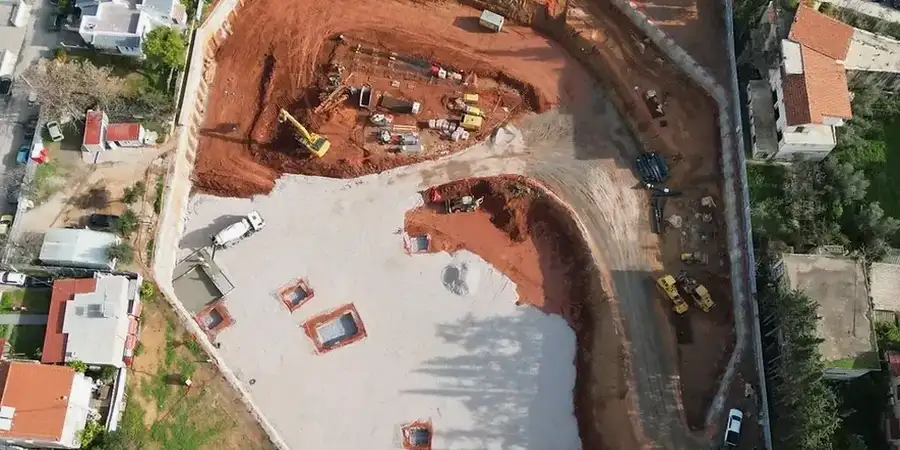
The hydraulic hammer on the H-pile rig pounds in a steady rhythm off Kildaire Farm Road. Crews are driving soldier beams into partially weathered rock for a new parking structure. Deep excavation in Cary starts with a clear understanding of what lies beneath the surface: residual silty sands from the Pinehurst Formation, underlain by saprolite and weathered gneiss. These Piedmont soils do not behave like textbook materials. We rely on in-situ data from CPT testing to map the transition from stiff clay to decomposed rock, and we correlate those readings with SPT drilling logs to confirm refusal depth and bearing layers before designing the shoring system. Every cut below 15 feet in Wake County demands a signed, sealed submittal from a licensed engineer who knows the local geology firsthand.
The biggest risk in Piedmont excavation is not collapse during construction — it is the slow, delayed movement of a cut slope that saturates over a wet winter.
How we work
Local ground factors
Cary grew fast. What was farmland along Highway 64 in the 1980s is now a dense corridor of offices, hotels, and retail. That history matters for deep excavation because decades of cut-and-fill operations have left undocumented fill pockets across town — loose soil that contractors discover only when the excavator bucket hits something that does not match the boring log. The risk shows up as localized instability, unexpected groundwater perched on old clay layers, or vibration-induced settlement in adjacent structures built on shallow footings. We address this with pre-construction condition surveys, staged excavation sequences, and contingency triggers written directly into the shoring plans. When the cut is deeper than 20 feet, we also run a settlement analysis for nearby utilities and coordinate with the Town of Cary Engineering Department on right-of-way protection measures.
Regulatory framework
IBC 2021 Chapter 33 – Safeguards During Construction, FHWA GEC No. 4 – Ground Anchors and Anchored Systems, ASTM D1586-18 – Standard Test Method for SPT and Split-Barrel Sampling, OSHA 29 CFR 1926 Subpart P – Excavations, NCDOT Standard Specifications for Roads and Structures (latest edition)
Complementary services
Shoring Design and Submittal Package
Complete design of soldier pile walls, secant pile walls, and sheet pile cofferdams for cuts up to 80 feet. Includes earth pressure calculations, tieback bond length verification, waler and lagging design, basal stability checks, and construction sequence notes. Package is sealed by a NC-licensed Professional Engineer and ready for Town of Cary permit review.
Dewatering and Groundwater Control Plan
Hydrogeologic assessment and dewatering system design for excavations below the water table. We size deep wells or wellpoints based on pumping test data, estimate drawdown radius, and prepare the NPDES permit application package. Plan includes settlement analysis for off-site structures within the cone of influence.
Typical parameters
Questions and answers
What is the typical cost range for a deep excavation design in Cary?
For most commercial projects in Cary, the design package for a shored excavation falls between US$2,220 and US$8,090, depending on depth, shoring type, and the number of tieback levels. A 20-foot soldier pile wall with one row of anchors runs toward the lower end. A 60-foot secant pile wall with groundwater cutoff and multiple anchor levels moves toward the higher end. Each quote is project-specific and based on the boring logs and architectural drawings provided.
How do Piedmont residual soils affect shoring design?
Residual soils derived from weathered gneiss and schist behave as stiff, overconsolidated clays with significant cohesion that can degrade upon exposure to water. We use drained shear strength parameters from triaxial tests and apply the FHWA apparent earth pressure diagram for stiff fissured clays. The critical design case is often the long-term condition after the excavation has been open for several months and the soil has had time to relax and saturate.
What monitoring is required during a deep excavation in Cary?
At minimum, we specify optical survey points on the shoring wall and on adjacent structures within the zone of influence. For excavations deeper than 30 feet or near sensitive structures, we add inclinometers behind the wall to track subsurface movement and vibrating wire piezometers to verify that the dewatering system is maintaining the design drawdown. Readings are taken daily during active excavation and weekly during the open-cut phase.
How long does the design and permitting process take?
A typical shoring design package takes three to four weeks from receipt of a complete geotechnical report. The Town of Cary review cycle adds approximately two to three weeks for commercial projects. We coordinate directly with the plan reviewer to address comments and avoid resubmittal delays.