The most expensive mistake we see in Cary foundations is assuming stiff near-surface soils won't settle under moderate loads. The Piedmont residual profile is deceptive: a weathered crust over partially decomposed rock and saprolitic zones that can compress more than 2 inches under footing pressures, especially when site drainage isn't controlled during construction. A conventional spread footing can meet bearing capacity but still exceed serviceability limits if compressible seams aren't identified early. Stone column design addresses exactly that — transferring load through the questionable upper strata into competent material while providing radial drainage that accelerates consolidation in low-permeability silts. Whether the project is a mid-rise medical office near the SAS campus or a tilt-up warehouse in West Cary's Triassic basin, the column grid, length, and diameter must be calibrated to actual subsurface variability. We often recommend coupling the design phase with a CPT test to map the saprolite transition depth continuously before finalizing the column layout.
In Cary's Piedmont residual soils, stone column design is less about bearing failure and more about controlling differential settlement in saprolite transitions.
How we work
Local ground factors
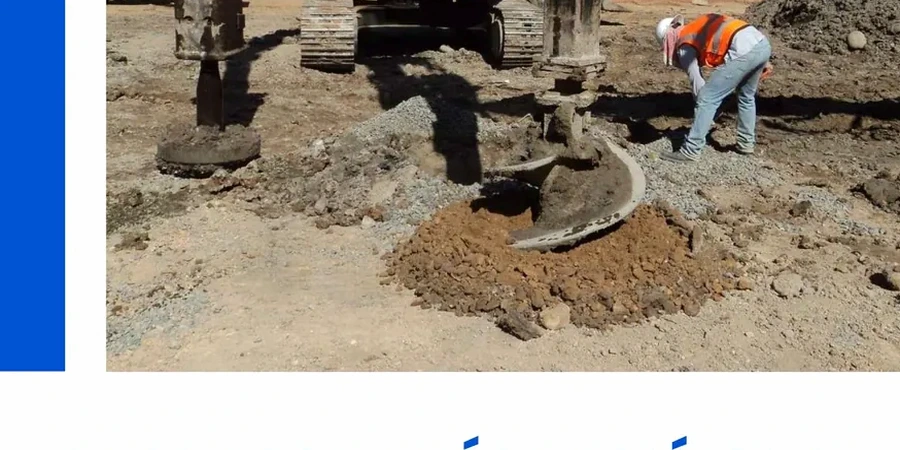
A vibroflot or top-feed vibro-replacement rig works by penetrating the ground under its own weight plus water flush, then backfilling with clean stone in lifts while the vibrator compacts the column radially. In Cary, the biggest operational risk is encountering a perched water table within the upper 8 feet of residual silts — something we have documented on multiple sites near Lake Crabtree. That changes the installation from dry bottom-feed to wet top-feed, and if the design didn't anticipate it, column continuity suffers. We have seen columns neck or lose stone volume through sidewall erosion in saturated micaceous silts, which then require re-drilling and spoil management that wasn't budgeted. The design phase must therefore include a thorough review of seasonal groundwater data and at least one piezometer reading during the geotechnical investigation. Another risk is lateral displacement of adjacent footings when columns are installed within 6 feet of existing structures; we specify vibration monitoring and a sequence that places perimeter columns first as a confinement barrier.
Regulatory framework
ASTM D1586-18 Standard Test Method for Standard Penetration Test (SPT) and Split-Barrel Sampling of Soils; ASCE/G-I 53-10 Compaction Grouting Consensus Guide (design principles adapted for vibro-replacement); IBC 2021 Section 1806—Presumptive Load-Bearing Values and Ground Improvement Provisions; and FHWA-NHI-16-027 Ground Improvement Methods Manual, Vol. I & II (vibro stone columns).
Complementary services
Settlement-driven column grid design
We calculate the area replacement ratio, column spacing, and depth based on allowable total and differential settlement for the specific structure type — not just a generic bearing capacity check.
Post-installation load testing specification
We prepare the testing protocol, acceptance criteria, and modulus improvement factor targets for plate load tests or zone load tests on trial and production columns.
Drainage and lateral displacement analysis
For Cary sites with shallow groundwater or adjacent structures, we model radial drainage consolidation rates and specify vibration monitoring thresholds and column installation sequence.
Typical parameters
Questions and answers
What typical settlement reduction can stone columns achieve in Cary's Piedmont soils?
In the residual silts and saprolite common around Cary, we typically target a settlement reduction ratio between 2 and 4, meaning the treated ground settles one-half to one-quarter as much as untreated soil under the same load. The exact ratio depends on the area replacement percentage, column stiffness, and whether a load transfer platform is included.
How deep do stone columns need to go in Cary to be effective?
Most designs in this area require columns between 15 and 35 feet deep. The key is penetrating at least 2 feet into competent partially weathered rock or saprolite with SPT N-values above 30. Shallower columns in deeper weathering zones often fail to control settlement adequately.
What is the typical cost range for stone column design in Cary?
Can stone columns be installed close to existing buildings in downtown Cary?
Yes, but it requires special care. We specify vibration monitoring with a peak particle velocity limit of 0.5 in/sec at the nearest foundation and sequence the installation so perimeter columns are placed first as a confinement barrier. For distances under 6 feet, we may recommend a pre-drilled pilot hole or a reduced-amplitude start.
How do you verify that stone columns are performing as designed?
We specify post-installation plate load tests on at least one column per zone, following ASTM D1194/D1194M, with acceptance based on a modulus improvement factor or a load-settlement curve within the design envelope. We also recommend column modulus tests using a probe to check stiffness uniformity along the column depth.