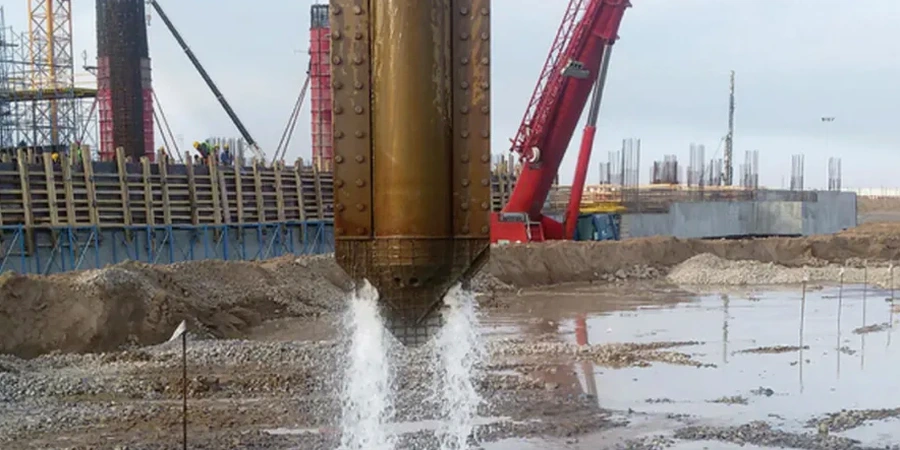
Cary’s transformation from a quiet railroad stop into a thriving Triangle tech hub brought dense commercial parks and residential subdivisions onto the region’s characteristic Piedmont residual soils. Beneath the stiff silty clays, deep deposits of loose alluvial sand—remnants of ancient stream terraces—pose a real challenge for shallow foundations. Our geotechnical laboratory has designed vibrocompaction treatment grids across western Wake County for over a decade, tailoring depth, spacing, and energy input to the specific gradation of each site. A well-calibrated vibrocompaction program densifies these soils in place, slashing post-construction settlement and boosting bearing capacity without importing select fill. Before launching a full-scale treatment plan, we frequently verify liquefaction susceptibility through SPT drilling and confirm grain-size distributions with laboratory sieve analysis to ensure the soil matrix will respond to vibratory energy.
A properly executed vibrocompaction grid can raise relative density in clean sands from below 40 percent to over 75 percent, effectively eliminating liquefaction risk under the design earthquake.
How we work
Local ground factors
The upper Coastal Plain sediments underlying eastern Cary contain loose, poorly graded sand lenses deposited during Pleistocene high-stand events; these layers, often encountered between 15 and 45 ft below surface, are highly susceptible to both static settlement and seismically induced liquefaction. Skipping a site-specific vibrocompaction design on these materials risks differential settlement that can shear utility connections, crack slab-on-grade floors, and misalign structural frames—problems we have seen in forensic investigations where pre-treatment was omitted. The North Carolina state modifications to the IBC require liquefaction assessment for sites in Seismic Design Category C and above, which covers most of Wake County. Our approach addresses this head-on: we quantify pre-treatment penetration resistance, design a compaction grid that forces excess pore pressure dissipation through controlled drainage paths, and validate the outcome with before-and-after data the structural engineer can use directly in foundation calculations.
Watch the video
Regulatory framework
ASCE 7-22: Minimum Design Loads and Associated Criteria for Buildings and Other Structures, IBC 2024 Chapter 18: Soils and Foundations, ASTM D1586-18: Standard Test Method for Standard Penetration Test (SPT) and Split-Barrel Sampling of Soils, ASTM D5778-20: Standard Test Method for Electronic Friction Cone and Piezocone Penetration Testing of Soils, FHWA-NHI-16-072: Ground Improvement Methods – Vibrocompaction Chapter
Complementary services
Vibrocompaction Feasibility and Trial Program
We review existing borings, run grain-size and plasticity tests on target sand layers, and design a trial grid with 3 to 5 probe points to confirm energy transfer and radius of influence before full-scale production.
Production Grid Design and Monitoring Plan
Triangular or square grid layout with specified vibrator frequency, amplitude, probe diameter, and stage timings. The monitoring plan defines real-time acceptance criteria for amperage, depth, and vibration duration per increment.
Post-Treatment Verification and Reporting
SPT or CPT testing at prescribed grid nodes, sand cone density tests at shallow intervals, and a stamped final report with before-and-after relative density profiles, liquefaction factor of safety, and bearing capacity recommendations.
Typical parameters
Questions and answers
What does vibrocompaction design cost for a typical Cary building site?
For a commercial lot in the 1- to 3-acre range with loose sand starting at 15–20 ft, the design package—including feasibility review, grid layout, monitoring specifications, and post-treatment verification—typically runs between US$1,540 and US$5,150. The spread depends on the number of pre-treatment CPT soundings required and the density of post-treatment verification points the building official requests.
How do you know if a Cary site is a good candidate for vibrocompaction instead of stone columns?
We run a grain-size analysis on the target layer first. If fines content is below 15 percent and the sand plots in the SP or SP-SM range, vibrocompaction is typically the faster and more economical choice. When silt or clay content exceeds 15 percent, or when interbedded cohesive layers would trap pore pressure, we shift the recommendation toward stone columns or deep soil mixing and explain the reasoning in the feasibility report.
How long does the field verification phase take after vibrocompaction is completed?
For a standard commercial footprint, post-treatment SPT or CPT verification and sand cone testing can be completed in one to two days on site. The final stamped report with bearing capacity values and liquefaction factors of safety is delivered within five to seven business days after field work wraps up, assuming no weather delays that would prevent rig access.