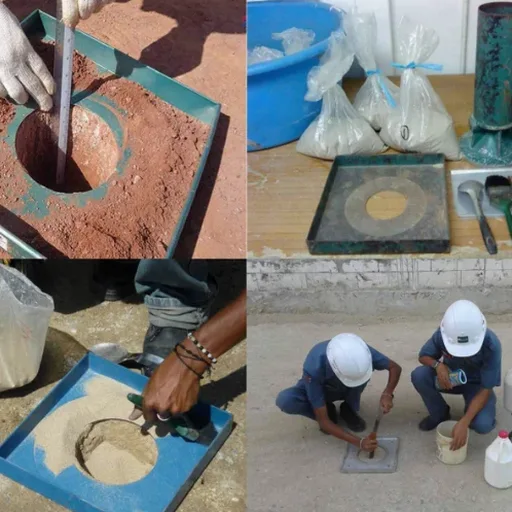
Between the dense, clay-rich residuum found near the Swift Creek bluffs and the looser, engineered fills common to the newer developments around the Wake County line, soil compaction in Cary can vary dramatically from one site to the next. A standard Proctor curve developed in the lab means little if the contractor’s field compaction effort fails to achieve the specified percentage, which is precisely why the sand cone density test remains the most direct method for verification. The team working in Cary relies on ASTM D1556 procedures to perform in-place density measurements that confirm whether each lift of fill meets the structural requirements before the next course is placed, closing the loop between the laboratory optimum and the reality of the jobsite where afternoon thunderstorms can alter moisture conditions in a matter of hours.
In Cary’s Cecil series clays, a 2 percent drop in moisture below optimum can make the difference between passing density and a failed lift.
How we work
Local ground factors
With Cary’s population now exceeding 180,000 and the town issuing permits for over 1,200 new residential units annually, the pressure to turn over pads and utility trenches on tight schedules has never been higher. Rushing to place the next lift before a density test is completed introduces a risk that compounds with every foot of untested fill, particularly in the smectite-rich clays that can shrink and swell enough to distort a slab-on-grade within the first two seasonal cycles. A failed density test caught early costs a few hours of re-rolling; a soft layer buried under a finished foundation can lead to differential settlement that triggers expensive forensic investigations and structural repairs. The sand cone method, when performed by a technician who understands how Cary’s humidity swings affect the Ottawa sand’s bulk density calibration, provides the documentation that protects both the builder and the owner.
Regulatory framework
The applicable standards for field density testing using the sand cone method in Cary’s variable soils include ASTM D155
Complementary services
Nuclear Gauge Correlation
For large commercial pads where sand cone tests would slow production, the team establishes a site-specific correlation between the nuclear gauge and the ASTM D1556 method, allowing the contractor to run rapid nuclear tests while the sand cone provides the legally defensible referee measurement at a lower frequency.
Compaction Troubleshooting with Proctor Verification
When multiple lifts fail at a single site, the crew pulls undisturbed tube samples and runs a fresh one-point Proctor to determine whether the fill material’s optimum moisture has shifted, a common occurrence in Cary when borrow sources change during mass grading.
Typical parameters
Questions and answers
How much does a field density test with the sand cone method cost in Cary?
What is the difference between the sand cone and a nuclear density gauge?
The sand cone measures density directly by excavating a small hole and weighing the removed soil, then filling the cavity with calibrated Ottawa sand. A nuclear gauge estimates density indirectly through gamma radiation attenuation. Because the sand cone is a direct volume measurement, it is considered the referee method and is required for final acceptance by many Cary-area geotechnical engineers.
How deep can the sand cone test measure?
The standard ASTM D1556 procedure measures one compacted lift at a time, typically 6 to 12 inches thick. For deeper verification, the crew can excavate in steps and test each successive lift, or pair the density test with a test pit investigation to log the entire fill profile.
Can you perform sand cone tests in gravelly soils?
The sand cone method is reliable for soils with a maximum particle size of about 1.5 inches. In Cary’s residual soils, this covers most weathered rock fill, but if the contractor is placing shot rock or cobble-sized material, the crew will recommend a test pit with a water replacement method instead.
How long does a single sand cone test take on site?
A single ASTM D1556 test, including excavation, weighing, and sand filling, requires roughly 15 to 20 minutes. The technician typically needs another 10 minutes to calculate the dry density and percent compaction on site so the contractor can proceed immediately if the lift passes.