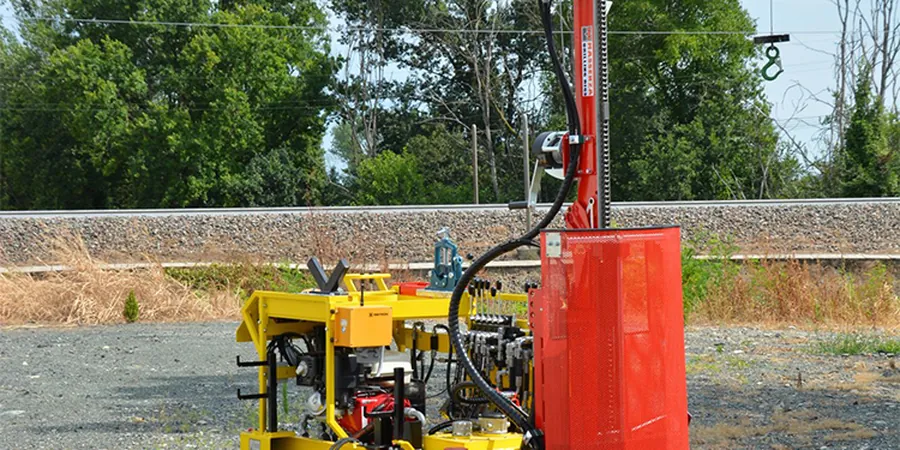
Cary sits right on that line where the Piedmont meets the Coastal Plain. On the west side you hit weathered rock at 15 feet; head east toward Apex and you might drill through 60 feet of silty sand before finding refusal. That shift makes the SPT non-negotiable for any project here. We run our rigs on everything from teardown rebuilds in older neighborhoods off Kildaire Farm Road to big commercial pads near SAS campus, and the one constant is that N-values tell you exactly what you're working with before concrete goes in. A standard penetration test per ASTM D1586 gives us blow counts, sample recovery, and a visual soil log that ties directly into bearing capacity calculations under IBC Chapter 18. For sites where the top 10 feet look soft, we often pair the drilling program with a CPT investigation to get continuous tip resistance and friction sleeve data, particularly when the client needs a refined liquefaction assessment or wants to compare SPT energy-corrected values against cone penetration results.
SPT N-values drive the entire foundation design, from bearing capacity to settlement to liquefaction screening—skipping the boring program isn't saving money, it's borrowing risk.
How we work
Local ground factors
The soil contrast between east Cary and west Cary catches people off guard. West of I-40, you're in residual silty clays from weathered granite and gneiss—decent bearing soil once you get past the topsoil, but excavation can be tough. East of the highway, closer to the Neuse River basin, you start seeing alluvial deposits, loose sands, and higher groundwater. We've drilled borings off Walnut Street where N-values came back in the single digits down to 25 feet, which triggers mandatory liquefaction screening under ASCE 7-22 for Seismic Design Category C sites. Another risk is fill material: older lots in the downtown Cary area sometimes have undocumented fill from decades ago, and SPT refusal on construction debris is more common than you'd think. Miss that, and you're looking at differential settlement later. Our reports flag these conditions explicitly, with recommended foundation alternatives and any need for ground improvement.
Watch the video
Regulatory framework
The project adheres to ASTM D1586-18 for Standard Penetration Testing and split-barrel sampling, ASTM D2487-17 for soil classification per the Unified Soil Classification System, IBC 2021 Chapter 18 for soils and foundations, and ASCE 7-22 for minimum design loads and associated criteria.
Complementary services
Residential SPT Package
Two to four borings, typically to 20-30 feet, with full logging and N-values. Includes bearing capacity recommendations for spread footings and a site classification per IBC Table 1604.5. Geared toward custom homes, additions, and pool foundations.
Commercial & Multi-Family SPT Program
Boring grid per IBC spacing requirements, depths to 50 feet or refusal. Provides N60 corrected blow counts, soil profile, groundwater monitoring well installation, and liquefaction screening where applicable. Delivered as a stamped geotechnical report ready for permitting.
Specialized SPT with Lab Testing
Adds laboratory classification to field logs: grain size analysis, Atterberg limits, moisture content, and unconfined compression on cohesive samples. Useful when fine-grained soils dominate the profile and swell potential or consolidation settlement needs quantification.
Typical parameters
Questions and answers
How many SPT borings does Cary require for a single-family home?
The Town of Cary generally follows IBC Table 1803.1, which means at least one boring for residential construction, but most structural engineers request two to four borings to capture soil variability across the lot. We recommend at least two borings on opposite corners of the footprint so you don't miss a fill pocket or a soft lens that would change the foundation design.
What does SPT testing cost for a typical Cary project?
How deep do you drill for an SPT boring in this area?
Depends on the structure and the soil. For a two-story house on spread footings, 20 to 30 feet is typical. For a four-story office building or a retaining wall over 10 feet, we go 40 to 50 feet or until refusal on competent rock. We follow the IBC rule of exploring to a depth where the added stress from the foundation is less than 10 percent of the original overburden stress.
Can SPT detect liquefaction risk in Cary?
Yes, it's one of the primary tools for liquefaction screening. We use the NCEER simplified procedure with SPT N-values corrected to N60, factoring in fines content and overburden pressure. East Cary sites with loose sands and shallow groundwater—especially near stream corridors—sometimes trigger a liquefaction analysis requirement under ASCE 7, and the SPT data feeds directly into that calculation.
How long does it take to get the geotechnical report after drilling?
Drilling is usually one day for a residential job, maybe two for a larger commercial grid. After that, we need about five to seven business days to finish lab testing, run the engineering calculations, draft the report, and get the professional engineer's stamp on it. We can expedite to three days if the permit deadline is tight.