The International Building Code (IBC 2021) and ASCE 7-22 demand a thorough understanding of subsurface conditions before any structural design proceeds, a requirement that takes on particular significance in Cary, North Carolina. This town, located at the boundary between the Triassic basin and the crystalline Piedmont, presents a complex transition from saprolitic silts to residual sandy clays derived from weathered granite and gneiss. A soil mechanics study in Cary must therefore go beyond simple classification, quantifying strength parameters, compressibility, and potential volume change in materials that can vary dramatically across a single parcel. ASTM D2487 provides the systematic framework for describing these soils visually and in the laboratory, but the interpretation requires local experience with the region's deep weathering profile. The value of a properly executed Cary soil mechanics study lies in its ability to identify the depth to competent bearing strata and characterize the engineering behavior of the overlying residual mantle, which frequently exceeds 15 meters in this part of Wake County.
The engineering behavior of Piedmont residual soils in Cary is controlled more by relict structure and seasonal moisture variation than by simple index properties.
How we work
Local ground factors
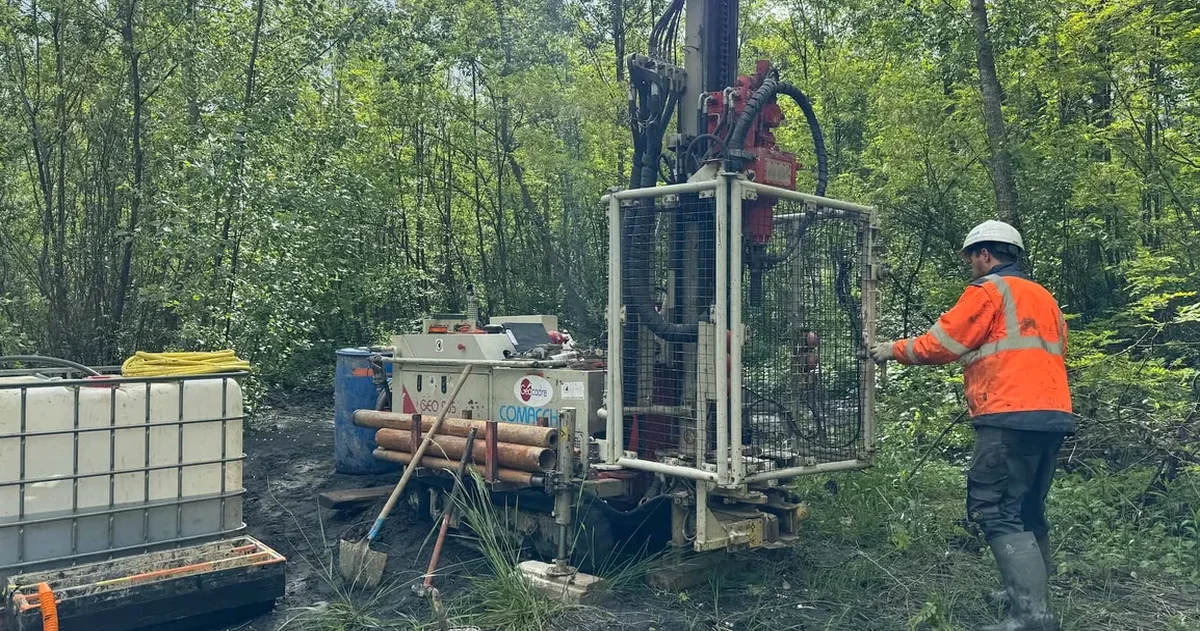
A recurring pattern in Cary involves cut-and-fill operations on sloping lots where the interface between compacted fill and natural residual soil creates a plane of hydraulic contrast. We have observed that water migrating along this interface can saturate the lower portion of the fill, reducing matric suction and triggering a loss of apparent cohesion that standard bearing capacity equations do not capture. A soil mechanics study in Cary that only reports saturated strength parameters from remolded specimens may miss this mechanism entirely. The residual soils themselves present another challenge: the relict structure inherited from the parent rock, including foliation planes and quartz veins, can impart anisotropic strength characteristics that are not evident in small-diameter triaxial specimens. For critical structures, we recommend supplementing the laboratory program with in-situ testing to validate the design parameters. The integration of a soil mechanics study with a CPT investigation provides a nearly continuous profile of tip resistance and sleeve friction, allowing the detection of thin, weak horizons that might be missed by conventional sampling intervals.
Watch the video
Regulatory framework
The classification of soils for engineering purposes follows ASTM D2487; consolidated undrained triaxial compression testing is performed in accordance with ASTM D4767; one-dimensional consolidation properties are determined per ASTM D2435; geotechnical investigations adhere to Section 1803 of the 2021 International Building Code; and minimum design loads are established by ASCE 7-22.
Complementary services
Classification and Index Testing
Determination of grain-size distribution by mechanical sieving and hydrometer (ASTM D422), Atterberg limits (ASTM D4318), and specific gravity. These index properties form the basis for classifying Piedmont residual soils and predicting their general engineering behavior.
Strength and Compressibility
Consolidated-undrained triaxial compression tests (ASTM D4767) to obtain effective stress parameters (c', φ'), and one-dimensional consolidation tests (ASTM D2435) to estimate settlement magnitude and rate. These parameters are essential for bearing capacity and settlement analysis in Cary's partially saturated silts.
Volume Change and Compaction
Evaluation of swell potential in the clay fraction and standard/modified Proctor tests (ASTM D698/D1557) to establish moisture-density relationships for engineered fill. This is critical in Cary, where some residual clays exhibit moderate to high plasticity and can cause structural distress if not properly managed.
Typical parameters
Questions and answers
What is the typical scope of a soil mechanics study for a single-family home in Cary?
For a typical residential lot in Cary, the scope generally includes a visual-manual classification of samples recovered from test borings, Atterberg limits and grain-size analysis on selected specimens, and one-dimensional consolidation or swell tests if the plasticity index exceeds 15. The investigation aims to provide allowable bearing pressure, anticipated settlement, and recommendations for foundation type, usually shallow footings bearing on competent residual soil. The laboratory program is designed according to the number of distinct strata encountered and the structural loads, following the minimum requirements of IBC Section 1803.
How do Piedmont residual soils differ from transported soils in a soil mechanics study?
Residual soils in Cary retain the fabric and mineralogy of the parent granite or gneiss, meaning their engineering properties often do not correlate well with standard sedimentary soil relationships. For example, the liquidity index concept can be misleading because these materials may exhibit a brittle, strain-softening response despite high natural moisture content. The relict foliation and jointing can also create planes of weakness that control slope stability and excavation behavior, requiring careful sampling orientation and interpretation of triaxial test results.
What is the cost range for a soil mechanics laboratory testing program in Cary?
How long does it take to receive the laboratory results for a soil mechanics study?
Standard index tests such as Atterberg limits and grain-size analysis can be completed within 5 to 7 business days. Consolidation tests require staged loading and typically need 10 to 14 days per specimen to produce a complete time-settlement curve. Triaxial compression testing, depending on the drainage conditions and the number of confining pressures, may extend the turnaround to 3 or 4 weeks. We provide preliminary parameters for urgent design decisions as soon as individual tests are concluded.