One of the costliest errors we see in Cary is treating the entire Triangle region as uniform ground. A developer will budget for a standard fixed-base steel frame, only to discover during peer review that the site sits on partially weathered saprolite with a sharp impedance contrast at the refusal depth. That combination—stiff residual soil over rock that isn't as competent as it looks—can amplify short-period motion right into the structural period of a three-story medical office building. We get called in at that point to retrofit the lateral system conceptually, and a base isolation seismic design strategy often ends up being the most rational path forward. Instead of fighting the ground motion with more steel and larger footings, we decouple the superstructure from the soil column entirely. For sites near the Swift Creek shear zone or where the CPT test refusal data shows a highly erratic rock surface, we combine the isolation design with a seismic microzonation study to characterize the site-specific spectra before sizing the isolators.
Decoupling the structure from Piedmont residual soil demands a site-specific spectrum—generic ASCE 7 coefficients won't capture the amplification that weathered rock produces in Cary.
How we work
Local ground factors
We see a real split between the older central Cary neighborhoods near downtown and the newer subdivisions carved into the Triassic basin sediments to the southwest. Downtown, the natural soils are fine-grained saprolitic silts with high mica content—they drain poorly and lose stiffness fast when the water table rises after a heavy hurricane-season rain. A fixed-base structure there can settle differentially enough to crack partition walls even without an earthquake. Out toward the Green Hope School Road area, the soil transitions to a stiffer, sandier residual from the felsic bedrock, and the shear-wave velocity in the upper 30 meters often pushes the site into a borderline Class C/D classification. That ambiguity is exactly where base isolation seismic design stops being a luxury and becomes a code-driven necessity. If the structural engineer designs to the Class C spectrum but the geophysical survey later confirms Class D conditions, the isolator displacement demand can jump by 40%. We catch that mismatch early by running the MASW survey to 100 feet and correlating the Vs profile with the boring logs before the first isolator prototype test is scheduled.
Regulatory framework
ASCE/SEI 7-22 Chapter 17: Seismic Isolation Requirements, IBC 2021 Section 1705.13.4: Special Inspections for Isolated Structures, ASCE/SEI 41-17: Seismic Evaluation and Retrofit of Existing Buildings (isolation retrofit provisions), AASHTO Guide Specifications for Seismic Isolation Design (for bridge applications)
Complementary services
Site-Specific Ground Motion Hazard Analysis
Probabilistic and deterministic seismic hazard assessment for the Cary site, incorporating the 2023 USGS NSHM updates. We deaggregate the hazard to identify the controlling magnitude-distance pairs and generate spectrum-compatible time histories for the nonlinear isolation analysis.
Isolation System Design and Nonlinear Modeling
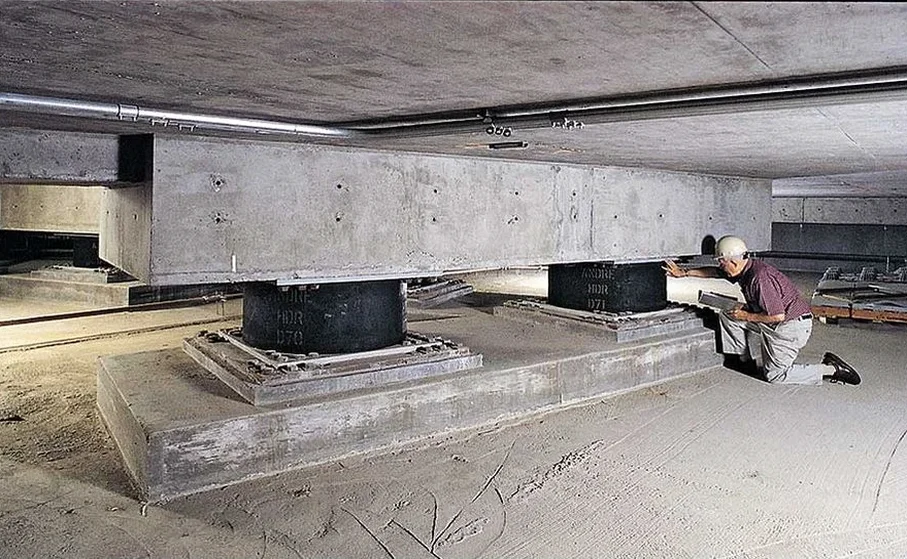
Selection and detailed modeling of elastomeric or sliding isolators in CSI ETABS or SAP2000. We develop the full bilinear or trilinear backbone curves from prototype test data, run the upper- and lower-bound sensitivity analyses, and verify that the isolation system meets the ASCE 7 stability and recentering criteria.
Peer Review and Special Inspection Coordination
We prepare the complete design basis report for the independent peer review panel and coordinate the special inspection program required by IBC Chapter 17. Our team reviews the isolator prototype test protocols to confirm they match the design assumptions before fabrication begins.
Typical parameters
Questions and answers
What's the engineering cost range for base isolation seismic design on a typical three-story commercial building in Cary?
For a mid-rise commercial project in Cary—say 30,000 to 60,000 square feet—the full isolation design package, including the site-specific hazard analysis, nonlinear time-history modeling, isolator specification, and peer review coordination, typically falls between US$4,330 and US$9,320. The spread depends on whether the site requires a probabilistic ground motion study from scratch and how many ground motion pairs the peer review panel requests. Simple projects on well-characterized Site Class C soils sit at the lower end; sites with complex geology near the Triassic basin boundary and a full suite of 11 ground motion pairs push toward the upper range.
How do you determine if a Cary site actually needs base isolation versus just a ductile moment frame?
We run a comparative seismic performance assessment early in schematic design. For the specific soil profile, we model both a fixed-base special moment frame and an isolated superstructure, then compare the expected annualized loss, the interstory drift, and the floor acceleration spectra. In Cary, where the soil profile often amplifies short-period motion, the isolated building typically shows a 60-80% reduction in total floor acceleration. If the program requires immediate occupancy after a design-level event—a hospital, a data center, a 911 dispatch—the isolation option almost always wins on lifecycle cost.
What isolator types do you typically specify for the saprolite residual soils common in the Triangle?
We lean toward triple friction pendulum bearings for most Cary commercial buildings. They handle the moderate displacement demands well, their effective radius and friction coefficient give us two independent parameters to tune the period and damping, and the recentering behavior is inherently strong. For lighter structures or where the architect wants a moat wall that doubles as a retaining element, we sometimes specify lead-rubber bearings with a shimmed elastomer compound tested for the local temperature range—Cary sees enough freeze-thaw cycles that the low-temperature stiffening effect needs to be in the upper-bound analysis.
Does the NC Building Code require peer review for seismically isolated structures?
Yes. Under IBC 2021, adopted by North Carolina, any structure using seismic isolation as the primary lateral force-resisting system requires an independent peer review of the isolation design and the prototype test program. We compile the complete design basis report—site-specific spectrum, isolator properties, analysis assumptions, upper- and lower-bound sensitivity results—and manage the review process with a qualified panel. The Cary plan review office has also started requesting the peer review summary letter as part of the building permit submittal for risk category III and IV isolated structures.