Cary's transformation from a railroad stop known as Page's Station in the 1850s into one of North Carolina's most rapidly growing municipalities has placed intense demand on its subsurface infrastructure. The Triassic Basin sedimentary rocks underlying western Wake County weather into silty clay residuum that can lose significant bearing capacity when saturated — a condition all too common during the Piedmont's humid summers. For pavement engineers working on subdivisions near Lake Crabtree or commercial pads off US-1, the soaked laboratory CBR test becomes the single most important index for predicting how the subgrade will behave under repetitive traffic loading after construction. An in-situ permeability test can flag drainage deficiencies in the same formation, while Proctor compaction testing establishes the moisture-density baseline against which CBR specimens are molded — without that correlation, soaked CBR values lack context for field inspection during earthwork.
A 2 percent change in compaction moisture can drop the soaked CBR of a Piedmont residual clay by 40 percent — we verify the Proctor curve before every CBR sequence.
How we work
Local ground factors
Cary sits within the Triassic Deep River Basin, where the contact between weathered siltstone and overlying residuum can change elevation by several meters over a single building lot. This lateral variability means two CBR specimens compacted from borings 30 meters apart may yield soaked CBR values of 4 and 12 — a difference that pushes the pavement designer from a full-depth asphalt section into a thickened aggregate base scenario. Ignoring that variability leads to premature fatigue cracking, particularly along collector streets like Green Level Church Road where truck traffic has increased with warehouse development. The 96-hour soak targets the worst-case saturation scenario: a perched water table forming after a hurricane remnant stalls over the Triangle, as occurred during Hurricane Matthew in 2016 when Cary's stormwater system was overloaded for 72 hours straight. We also cross-reference CBR results with soil resistivity measurements to identify zones where stray current from nearby utility corridors could accelerate pipe corrosion beneath the pavement, a secondary failure mechanism that pavement-only investigations routinely miss.
Regulatory framework
AASHTO T 193-22 — Standard Method of Test for CBR of Laboratory-Compacted Soils, ASTM D1883-21 — Standard Test Method for CBR of Laboratory-Compacted Soils, NCDOT Standard Specifications Section 500 — Subgrade Preparation and Pavement Materials, ASTM D1557-12(2021) — Modified Proctor Compaction (specimen preparation reference)
Complementary services
Soaked and Unsoaked CBR with Swell Monitoring
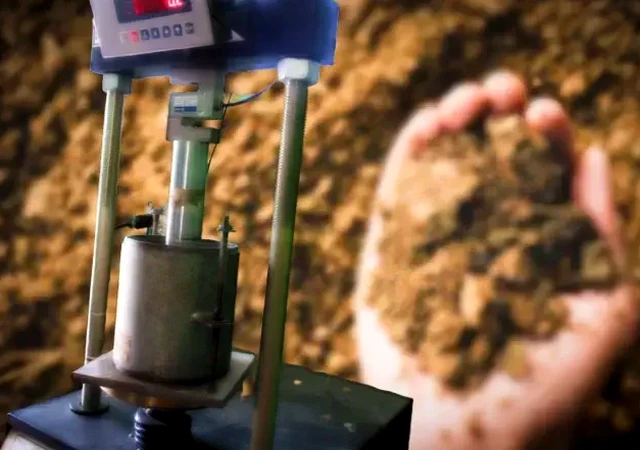
Full AASHTO T 193 protocol with 96-hour soak, daily swell readings, and corrected stress-penetration curves. We report CBR at 2.54 mm and 5.08 mm for both individual specimens and the averaged compaction curve, plus the swell percentage that directly informs the pavement designer's allowance for subgrade heave during the design life.
Multi-Point CBR vs. Compaction Correlation
Three-point or five-point compaction curves with CBR tested at each moisture-density coordinate. This approach is specified in NCDOT pavement design memos when the subgrade soil classification is borderline between A-6 and A-7-5 — a common scenario in Cary's transition zones between Cecil sandy loam and Appling silty clay.
Typical parameters
Questions and answers
How much does a laboratory CBR test cost for a Cary pavement project?
A single-point soaked CBR test with Proctor compaction reference typically ranges from US$130 to US$220 per specimen, depending on whether a full swell monitoring sequence is required and how many compaction points the correlation curve demands. A three-point CBR-compaction curve for NCDOT submittals falls at the upper end of that range because it involves nine compacted specimens rather than three.
Does NCDOT require soaked or unsoaked CBR values for subdivision streets in Cary?
NCDOT Standard Specifications Section 500 requires soaked CBR values for subgrade evaluation on all publicly maintained streets. The 96-hour soak under AASHTO T 193 is considered the design condition, and the pavement structural number is calculated using the soaked CBR as the resilient modulus proxy. Unsoaked values may be reported for contractor quality control during dry-weather construction but are not accepted for design submittals.
How long does a CBR test take from sample delivery to report?
Standard turnaround is 7 calendar days: 4 days for the 96-hour soak under controlled temperature, 1 day for penetration testing and swell measurement finalization, and 2 days for data reduction, curve correction, and report compilation. Expedited 5-day turnaround is available when the compaction curve has already been established and only the soaked CBR confirmation is needed.
What CBR value is considered acceptable for Cary's residual clay subgrades?
NCDOT pavement design tables assume a design CBR of 3 for A-7-5 clay subgrades, but many Cary sites with well-compacted Cecil sandy loam achieve soaked CBR values between 7 and 12. Values below 3 generally require subgrade stabilization with lime or cement, or a thickened aggregate base course to distribute traffic loads over the weaker stratum.
Can you run CBR tests on aggregate base course material, or only on subgrade soil?
CBR testing applies to both subgrade soils and unbound base course aggregates. For aggregate base, ASTM D1883 requires the material to be compacted in a 152.4 mm mold at optimum moisture, but the surcharge arrangement and penetration rate remain identical. We routinely test NCDOT Class II aggregate base and select fill materials to confirm they meet the minimum CBR of 80 specified for base course in flexible pavement sections.