The biggest variable beneath Cary isn't the saprolite depth—it's the transition zone where weathered rock still holds relict structure. We see anchors lose bond capacity here because the grout-to-ground interface behaves unpredictably across a single borehole. Our design approach accounts for this spatial variability directly. We don't assume a uniform bond stress down the bond length when site investigation shows alternating seams of silty sand and partially weathered gneiss. Before we finalize anchor spacing, we often correlate borehole logs with CPT test data to map the refusal horizon and confirm where the fixed anchor zone should sit.
A bond stress that works in competent gneiss at 25 feet depth will fail in the saprolite zone at 12 feet—Cary's geology forces that distinction.
How we work
Local ground factors
A hollow-stem auger with a casing advancer rig sits on a Cary commercial lot, drilling through 8 feet of stiff red clay into weathered gneiss. The risk isn't the drilling—it's the grout loss into open discontinuities 20 feet down. When grout takes more than twice the theoretical volume, the bond zone integrity is compromised. We mitigate this with stage grouting through a tube-à-manchette system, re-grouting after initial set. For anchors near Cary's Swift Creek floodplain, where groundwater sits at 6 feet, we specify watertight through-casing installation to prevent hole collapse. Every anchor gets a lift-off test 72 hours after lock-off to confirm seating loss hasn't exceeded 5% of the design lock-off load. The biggest hazard is assuming the weathered rock behaves like rock—it doesn't. It behaves like a transitional material that crumbles under high grout pressure, so we limit injection pressure to 50 psi in the bond zone.
Regulatory framework
ASTM D3966: Standard Test Methods for Deep Foundation Elements Under Lateral Load; PTI DC35.1: Recommendations for Prestressed Rock and Soil Anchors; IBC Chapter 18: Soils and Foundations (Seismic Design Category C provisions); FHWA-IF-99-015: Geotechnical Engineering Circular No. 4 - Ground Anchors and Anchored Systems; ACI 318-19: Building Code Requirements for Structural Concrete (anchor embedment).
Complementary services
Tieback Anchor Design for Excavations
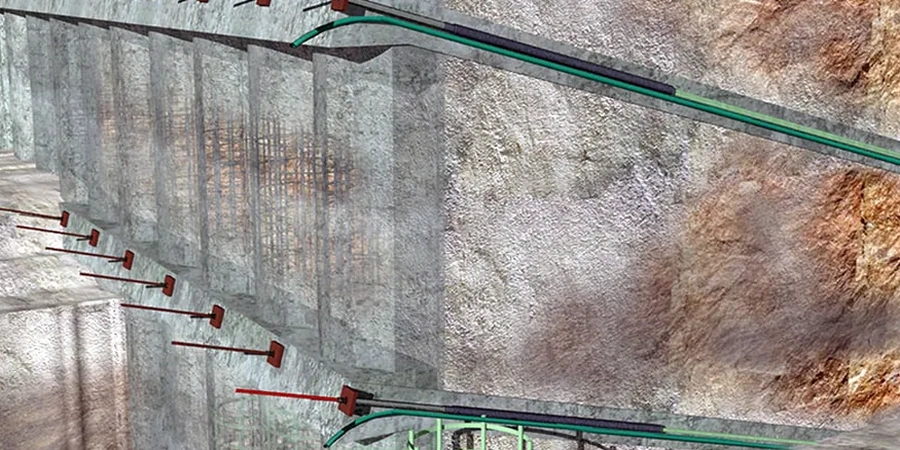
Active prestressed anchors for shoring walls in Cary's commercial developments. Includes soldier pile and lagging wall anchor integration with staged excavation sequencing.
Rock Slope Stabilization Anchors
Passive and active anchors for cut slopes in weathered gneiss and schist along Cary's roadway corridors. Design includes bench drainage and shotcrete facing coordination.
Anchor Load Testing & Verification
Performance tests, proof tests, and creep tests per ASTM D3966. We provide calibrated hydraulic jack systems and digital load cell monitoring with 0.1-kip resolution.
Typical parameters
Questions and answers
What is the difference between active and passive anchors?
Active anchors are prestressed to a specified lock-off load after installation—they actively apply force to the structure. Passive anchors are not tensioned; they develop resistance only when the ground or structure moves enough to engage them. In Cary, we use active anchors for excavation support where movement must be controlled, and passive anchors for rock slope reinforcement where some displacement is acceptable before the anchor engages.
How much does an anchor design and testing package cost in Cary?
Why are creep tests important for permanent anchors in Cary's soils?
Creep tests measure anchor displacement under sustained load over time. In Cary's Piedmont residual soils, the saprolite zone can exhibit time-dependent deformation under constant tension. A creep rate exceeding 1 mm per log cycle of time indicates inadequate bond zone performance. For permanent anchors, we run creep tests at 1.33 times the design load for 60 minutes minimum, per ASTM D3966.
What corrosion protection do Cary anchors require?
For temporary anchors with service life under 24 months, single corrosion protection with a corrugated sheath over the unbonded length is standard. For permanent anchors in Cary—especially in the moist, slightly acidic Piedmont soils—we specify Class I double corrosion protection: corrugated sheath over the full tendon length plus epoxy coating or encapsulation, with watertight seals at all transitions.