Slope engineering in Cary, North Carolina, encompasses the analysis, design, and stabilization of natural and constructed inclines to prevent failure and ensure long-term safety. The category covers everything from initial site characterization and slope stability analysis to the implementation of retention systems and drainage solutions. In a region experiencing rapid residential and commercial growth, the integrity of slopes directly impacts property values, infrastructure resilience, and public safety. Unstable slopes can lead to costly landslides, foundation distress, and regulatory non-compliance, making professional geotechnical input essential for any project involving grade changes.
The local geology of Cary and the broader Piedmont physiographic province presents unique challenges for slope design. The subsurface typically consists of residual soils derived from the weathering of underlying igneous and metamorphic rocks, primarily granites and gneisses of the Rolesville Batholith. These silty sands and sandy silts, classified as ML, SM, or MH under the Unified Soil Classification System, can lose significant strength when saturated. The transition zone between residual soil and partially weathered rock, known as saprolite, often retains the fabric of the parent rock but behaves as a soil, creating preferential seepage paths that reduce effective stress and trigger shallow failures. Understanding these transitional materials is critical for accurate modeling and intervention design.
Regulatory compliance in Cary is governed primarily by the North Carolina State Building Code, which adopts the International Building Code (IBC) with state-specific amendments. Chapter 18 of the IBC, addressing soils and foundations, mandates geotechnical investigations for any structure supported on or adjacent to slopes steeper than 1 unit vertical in 3 units horizontal. The Town of Cary’s Land Development Ordinance further requires slope evaluation and erosion control plans for any land-disturbing activity exceeding 10,000 square feet. For critical structures, design must consider a minimum factor of safety of 1.5 for static conditions, per guidelines from the North Carolina Department of Transportation and local practice. These regulations necessitate thorough subsurface exploration and laboratory testing to characterize in-situ strength parameters.
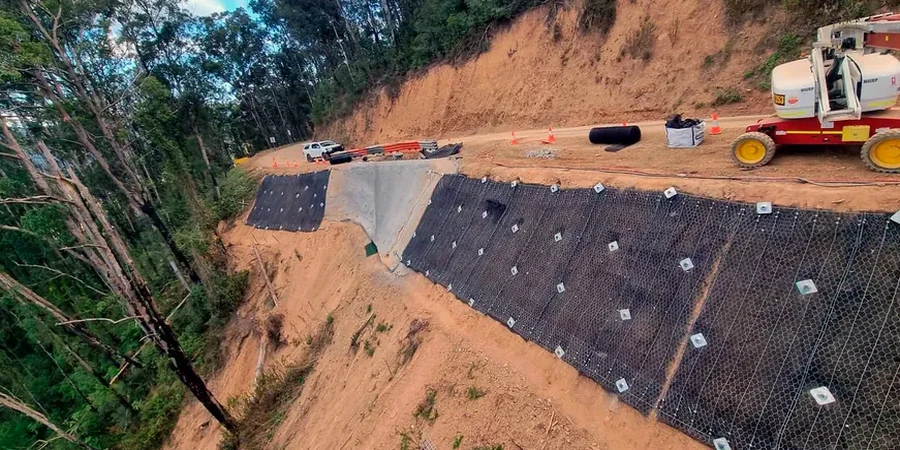
Projects that routinely require slope engineering services range from single-family home construction on hillside lots to large-scale infrastructure like roadway widenings along Highway 1 and Interstate 540. Commercial developments in the Alston Regional Activity Center often involve deep cuts and fills that demand sophisticated stabilization measures. For steep or constrained sites, active/passive anchor design provides a reliable solution to resist lateral earth pressures without excessive excavation. In-situ permeability testing, a key component of slope stability analysis, is crucial for designing underdrains and horizontal drains that mitigate pore-water pressure buildup, the most common trigger of slope movement in the Piedmont’s humid subtropical climate. Retaining walls, reinforced slopes, and soil nail systems all fall under this category’s purview when they are integral to global stability.
Questions and answers
What are the early warning signs of slope instability on a Cary property?
Common indicators include tension cracks in the ground or pavement, leaning or displaced retaining walls, bulging at the toe of a slope, and doors or windows that begin to stick. Tilting trees with curved trunks and the emergence of new seeps or saturated ground after rainfall also signal active movement. In Cary’s residual soils, these signs often appear after prolonged wet periods and warrant immediate evaluation by a geotechnical engineer.
How does the saprolite layer in Cary affect slope design?
Saprolite is a transition zone between soil and bedrock that retains the parent rock’s structure but has much lower strength. In Cary, this material can behave as a soil for excavation but contain relict joints that channel groundwater. Its heterogeneous nature complicates slope stability analysis because assumed soil parameters may not apply. Accurate characterization through test borings and in-situ permeability testing is essential to avoid underestimating seepage forces.
What is the typical factor of safety required for permanent slopes in North Carolina?
For permanent slopes supporting structures or roadways, a minimum static factor of safety of 1.5 is standard practice, as outlined by the North Carolina Building Code and NCDOT guidelines. This value accounts for uncertainties in soil strength, groundwater conditions, and loading. For temporary construction slopes, a lower factor of 1.3 may be acceptable, but seismic considerations can require a pseudostatic analysis with a reduced factor of safety of 1.1.
When is active anchor design preferable to a conventional retaining wall for slope stabilization?
Active anchor design becomes advantageous on steep, constrained sites where excavation for a large wall footing is impractical or would destabilize the slope further. Anchors, or tiebacks, prestress the ground to actively resist lateral forces before movement occurs, allowing for thinner wall sections and less excavation. This technique is often used in Cary for deep cuts along roadways or to stabilize existing walls showing signs of distress.
Location and service area
We serve projects across Cary North Carolina and surrounding areas.