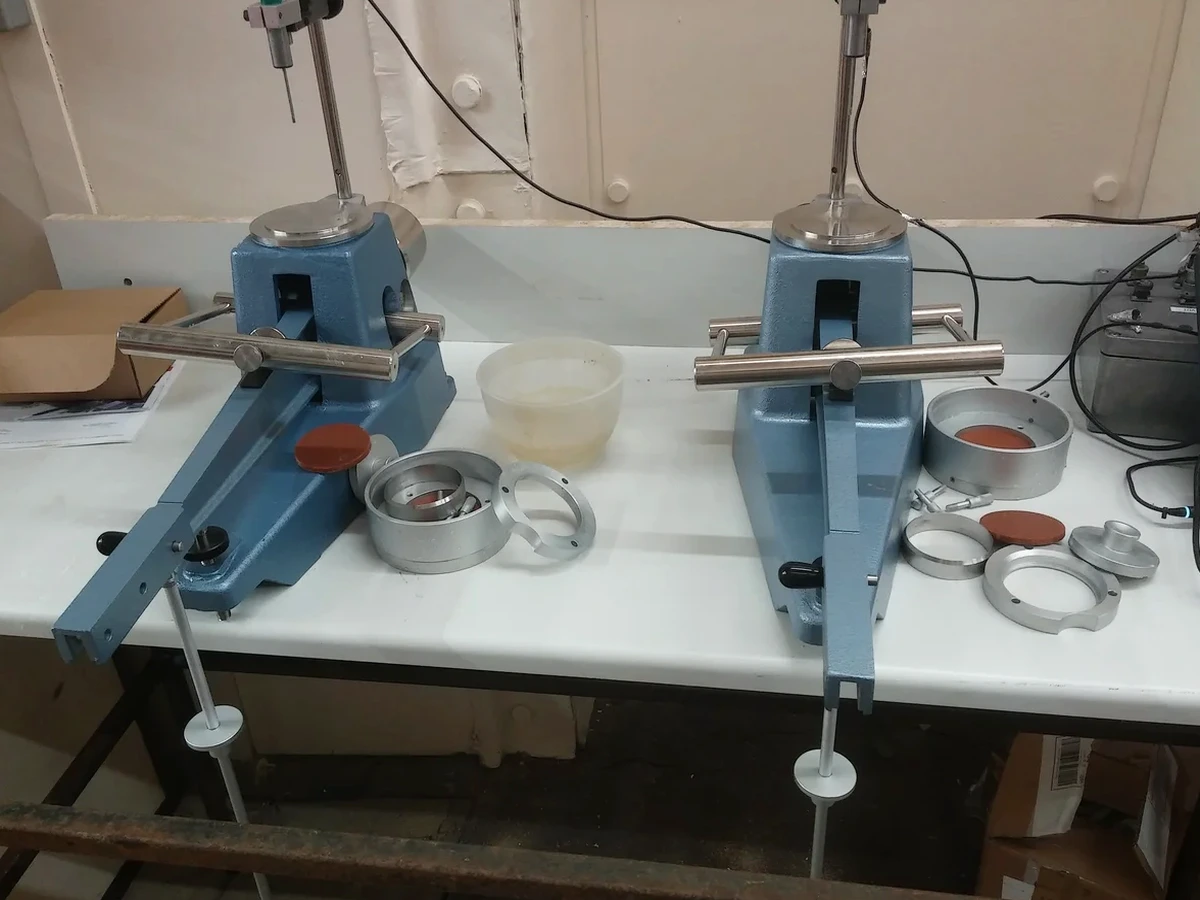
The red clay of Cary, North Carolina, tells a story that only a laboratory can read. The Piedmont residual soils here weather directly from the underlying bedrock. They carry high plasticity. They shrink. They swell. That behavior dictates foundation design and pavement performance across Wake County. Our lab runs Atterberg limits testing per ASTM D4318 to classify these fine-grained soils. We measure the liquid limit. We determine the plastic limit. Then we calculate the plasticity index. These three numbers separate a stable subgrade from a problematic one. For sites near the Swift Creek basin or along the growing corridors west of NC-55, we often combine this test with grain size analysis to build a complete USCS classification. The Cary climate adds urgency to getting these numbers right. Humid summers and periodic drought cycles stress the clay fraction in ways that make Atterberg data indispensable for long-term performance.
The plasticity index of Piedmont residual clay in Cary often exceeds 25, signaling high expansion potential that directly impacts foundation design.
How we work
Local ground factors
ASTM D4318 requires strict moisture control throughout the test sequence. In Cary, the humidity inside the lab can affect the rate of moisture loss during the plastic limit thread rolling. Our technicians monitor ambient conditions continuously. They work in a climate-controlled environment set to 23 degrees Celsius with relative humidity below 50 percent. The bigger risk sits in the field, not the lab. A soil classified as low-plasticity silt can behave like a high-plasticity clay if the sample is not properly sealed during transport from the Cary site to our facility. We reject samples that arrive with visible moisture loss or contamination. For deep excavations in the Triassic basin sediments east of Cary, we cross-reference Atterberg results with triaxial shear testing to confirm strength parameters under saturated conditions. Misidentified plasticity costs money. It causes foundation heave. It cracks pavements. The lab data must be defensible.
Regulatory framework
ASTM D4318-17e1: Standard Test Methods for Liquid Limit, Plastic Limit, and Plasticity Index of Soils, ASTM D2487-17: Standard Practice for Classification of Soils for Engineering Purposes (Unified Soil Classification System), ASTM D422-63(2007): Standard Test Method for Particle-Size Analysis of Soils
Complementary services
Atterberg Limits Determination
Complete liquid limit, plastic limit, and plasticity index testing per ASTM D4318. Includes flow curve plotting, moisture content verification, and USCS classification assignment. Suitable for foundation design, pavement subgrade evaluation, and borrow source qualification.
Soil Classification Package
Combined Atterberg limits, grain size distribution (sieve and hydrometer), and specific gravity. Delivers a full ASTM D2487 USCS classification with AASHTO group index for road projects. Recommended for sites with mixed alluvial and residual soil profiles.
Typical parameters
Questions and answers
What is the standard turnaround time for Atterberg limits testing in Cary?
Standard turnaround is 24 to 48 hours from sample receipt. Rush service is available for time-sensitive projects. The test itself requires approximately 16 hours of drying time plus the hands-on testing sequence, so same-day results are not feasible under ASTM D4318.
How much does Atterberg limits testing cost per sample?
Atterberg limits testing in Cary typically runs between US$60 and US$110 per sample, depending on whether you need just the liquid limit and plastic limit or the full classification package with grain size and hydrometer analysis.
What sample size is required for Atterberg limits testing?
We need approximately 500 grams of material passing the No. 40 sieve for a complete Atterberg limits test. The field sample should be larger, typically 2 to 3 kilograms, to account for the coarse fraction that will be removed during preparation.
Can you test soil samples with high organic content?
Yes, but with limitations. ASTM D4318 allows testing of organic soils. However, oven drying at 110 degrees Celsius can alter the properties of highly organic material. We note organic content on the report and discuss potential effects on the plasticity index with the project engineer before testing.
How do Atterberg limits relate to expansive soil potential in Cary?
The plasticity index correlates directly with swell potential. In Cary's Piedmont residual clays, a PI above 25 indicates high expansion potential. A PI above 35 signals very high expansion potential. These thresholds guide foundation depth recommendations and the need for moisture-controlled compaction or chemical stabilization.