A three-story medical office off Tryon Road started showing hairline cracks in the slab within six months of completion. The culprit wasn't the concrete—it was differential settlement from footings sized for generic 'stiff clay' that didn't account for the saprolite lenses we see across Cary. Our team pulled Shelby tubes, ran a full consolidation suite, and the second iteration of the shallow foundation design held within 0.3 inches of predicted settlement. That project taught us something we apply every day: in the Piedmont, the bearing layer isn't always what it looks like in the auger cuttings. For sites near the Swift Creek watershed where residual silts transition into partially weathered rock, we often pair our bearing capacity calculations with grain-size analysis and Atterberg limits to catch that tricky intermediate geomaterial before it surprises anyone.
Allowable bearing pressure isn't a soil property—it's a design decision that ties settlement tolerance, footing geometry, and subsurface variability into one number.
How we work
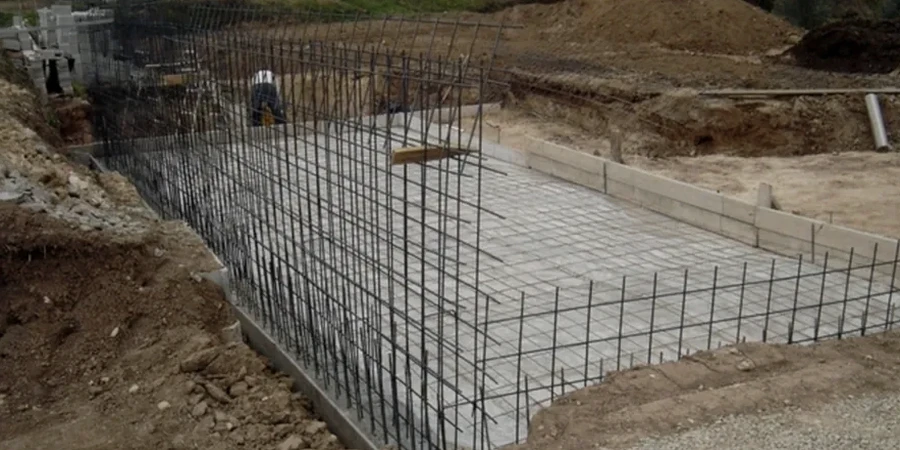
Local ground factors
Cary sits squarely in the Piedmont physiographic province, where the near-surface geology alternates between residual silts (ML), micaceous silty sands (SM), and weathered gneiss saprolite that loses 60-70% of its strength when remolded. Groundwater, perched above the rockhead, fluctuates from 3 feet in winter to 8 feet by August. A shallow foundation design that ignores this seasonal swing can underestimate consolidation settlement by a factor of two—the silts drain slowly, and the added moisture cuts effective stress right when the structural load comes on. Seismic demands from the AASHTO LRFD map show S_DS around 0.15-0.20g in southern Wake County, not high enough to govern most shallow foundations, but enough that we check the bearing capacity reduction under the 0.7E load combination per ASCE 7 Section 12.13. The real risk isn't a bearing failure—it's a serviceability failure from differential movement that the EOR didn't model.
Regulatory framework
The design of shallow foundations in Cary, North Carolina, adheres to IBC 2021 (Chapter 18: Soils and Foundations) for bearing capacity and settlement control, with loading criteria per ASCE/SEI 7-22, field evaluation via ASTM D1194-18 plate load tests, soil classification per ASTM D2487-17, structural concrete design per ACI 318-19, and guidance from FHWA NHI-05-037 on shallow foundations.
Complementary services
Bearing Capacity and Settlement Analysis
Footing sizing using Vesic, Terzaghi, and Meyerhof methods with settlement computed via Schmertmann (CPT or SPT input) and consolidation theory for cohesive layers. We deliver a bearing pressure map per column and wall line.
Ground Improvement for Footing Support
When near-surface soils fall below 2,000 psf, we design compacted structural fill pads, moisture-conditioned subgrades, or geogrid-reinforced layers to bring the bearing stratum up to the required stiffness without switching to deep foundations.
Mat Foundation Design
Full mat analysis using modulus of subgrade reaction (k_s) calibrated to plate load tests or SPT correlations. We model soil-structure interaction for combined footings and mats under irregular column grids, common in Cary's mixed-use developments.
Typical parameters
Questions and answers
How deep do footings need to be in Cary, NC?
The IBC prescribes a minimum of 12 inches below undisturbed ground surface for frost protection in this region, but our designs typically call for 18 to 30 inches to get below the organic topsoil and the zone of seasonal moisture fluctuation. In the silty residual soils common across Wake County, that extra depth also helps avoid the shrink-swell movement that damages slabs at shallower embedments.
What does a shallow foundation design package cost for a typical Cary commercial lot?
Do I need a geotechnical investigation if the soil looks like stiff red clay?
Yes. The red silty clays of the Piedmont can look competent in a test pit but contain lenses of micaceous sand or partially weathered rock that create differential settlement problems. The IBC requires a geotechnical report for all structures except detached one- and two-family dwellings, and even then, the Town of Cary often requests one when the site is on slopes greater than 15 percent or within the Swift Creek watershed overlay district.