Cary sits on the Piedmont plateau, where residual silty sands and partially weathered rock make every foundation a unique puzzle. At 495 feet elevation, the transition zone between the Triassic basin saprolite and deeper crystalline bedrock creates variable conditions that standard penetration tests alone cannot resolve. We run triaxial compression tests because the undrained shear strength of these Piedmont residual soils often governs deep excavation stability and slope design in Wake County. The CPT test provides continuous profiling through the weathered zone, but only a consolidated-undrained triaxial with pore pressure measurement reveals whether the fine-grained matrix will drain or build excess pressure under load. Our lab processes samples from Cary, Apex, and Morrisville within 48 hours, following ASTM D4767 and D7181 protocols. For large commercial pads, we often pair triaxial data with slope stability analysis to verify cut geometries through the variable saprolite horizon.
Effective friction angles in Cary saprolite can drop from 34 to 26 degrees with just a 5% increase in saturation — the difference between a safe cut and a failure.
How we work
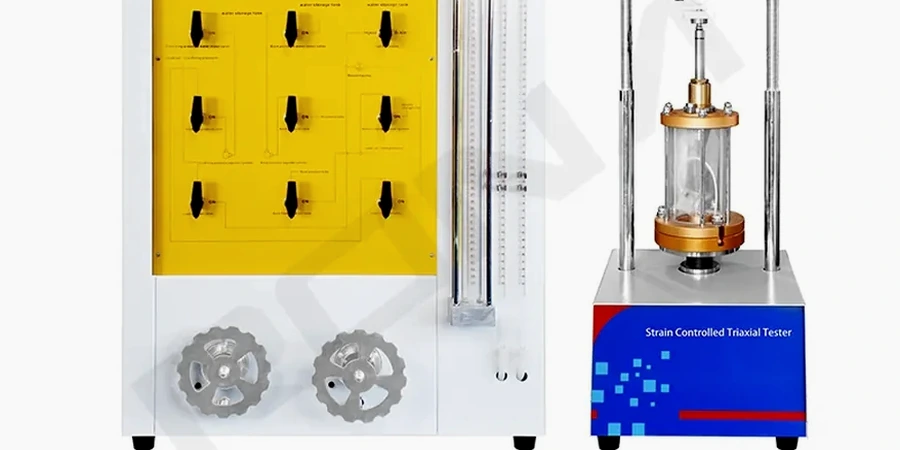
Local ground factors
Cary averages 46 inches of rain annually, and the Piedmont's clay-rich saprolite holds moisture like a sponge. A triaxial test run on a sample at natural water content tells one story — the same soil after a tropical storm tells another. Pore pressure builds fast in these low-permeability materials, and without a consolidated-undrained test with pore pressure measurement, you are guessing at effective stress. We have seen retaining wall designs in western Cary where the designer assumed drained strength parameters from a textbook, only to discover that field conditions never fully drain during construction. The Skempton A parameter at failure often exceeds 0.8 in these soils, meaning excess pore pressure dominates the stress path. For deep excavations near Crabtree Creek or any project within the Swift Creek watershed, ignoring the undrained behavior of residual soils is a risk the budget cannot carry.
Regulatory framework
ASTM D2850-18, ASTM D4767-11, ASTM D7181-20, AASHTO LRFD Section 10
Complementary services
Unconsolidated-Undrained (UU)
Quick undrained shear for clayey saprolite and short-term excavation stability. Three specimens at varying confining stress, run per ASTM D2850.
Consolidated-Undrained (CU) with Pore Pressure
Back-pressure saturated to B≥0.95, then sheared with pore pressure transducer. Provides effective stress parameters c' and φ' for long-term design.
Consolidated-Drained (CD)
Slow shear with full drainage, per ASTM D7181. Used for embankment analysis and long-term slope stability where drained conditions prevail.
Stress Path & Modulus
We report secant modulus at 50% strain (E₅₀), Skempton A at failure, and stress path plots for advanced constitutive model calibration.
Typical parameters
Questions and answers
What does a triaxial test cost in Cary NC?
Triaxial testing in Cary ranges from US$1,860 to US$2,700 depending on the test type (UU, CU, or CD) and number of confining pressures. A standard three-specimen CU set with pore pressure measurement falls at the higher end. Discounts apply when bundled with Shelby tube sampling or multiple borehole programs.
How long does a triaxial test take from sampling to report?
Unconsolidated-undrained (UU) tests can be completed within 48 hours of sample arrival. Consolidated-undrained (CU) tests require saturation and consolidation stages that typically extend the timeline to 5–7 business days. Consolidated-drained (CD) tests run the longest due to slow shear rates. We expedite reporting for active construction sites when advance notice is given.
Which triaxial test type do I need for a retaining wall design in Cary?
For retaining walls in Cary's residual Piedmont soils, we recommend a consolidated-undrained (CU) test with pore pressure measurement. The saprolite here often behaves as an undrained material during excavation but transitions toward drained behavior over the wall's service life. A CU test provides both undrained shear strength for construction staging and effective stress parameters (c', φ') for the permanent design condition.
How do you handle sampling disturbance in Piedmont residual soils?
Sampling disturbance is a real concern in Cary's saprolite because the soil fabric is brittle and sensitive to remolding. We use thin-walled Shelby tubes with a 3-inch diameter and low penetration ratios. Upon extrusion, each specimen is visually inspected for fissures or swelling before trimming. The B-value check during saturation often reveals whether the in-situ structure was preserved — a specimen that fails to reach 0.95 B under backpressure likely suffered disturbance during sampling or transport.